
CTET EVS Pedagogy: Concepts, Activities and Child-Centred Learning
Prepare Environmental Studies pedagogy with observation-based activities, local contexts, integrated learning, assessment ideas and examples for primary classrooms.
Environmental Studies is most meaningful when children connect ideas to what they observe at home, school, in their neighbourhood and in the natural world. For CTET, revise the subject themes alongside the methods that help children investigate, discuss and explain what they notice.
1. EVS connects knowledge with everyday experience
Primary EVS commonly connects family and friends, food, shelter, water, travel, things we make and do, and the environment. These are not merely lists of facts. They offer opportunities to observe relationships, compare experiences and ask questions. A lesson on water can include sources, uses, storage, cleanliness and responsible use, not just a definition copied from the board.
The CTET September 2026 bulletin says Paper I EVS items assess concepts, problem-solving and pedagogical understanding based on the primary syllabus. For each theme, ask: what should a child understand, and what activity would give the child evidence to think about?
2. Begin with investigable questions
Good investigation questions are answerable through observation, discussion, simple comparison or reliable sources. “Which places around our school have shade at noon?” invites observation. The teacher can begin with children's ideas, then help refine them with evidence instead of immediately announcing a final answer.
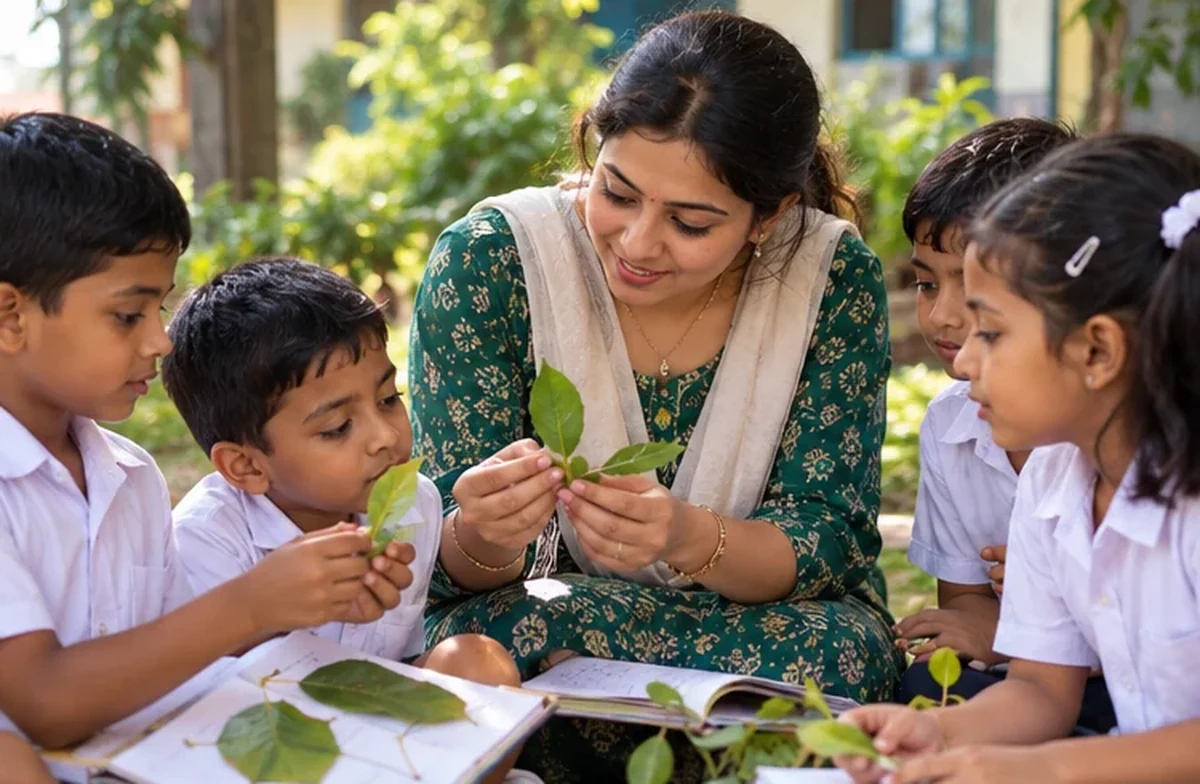
- Observe two leaves and record similarities and differences.
- Map how drinking water reaches the classroom and how it is stored safely.
- Compare materials used in different homes or shelters without ranking families.
- Discuss how travel choices affect time, cost, safety and the environment.
3. Use the local environment as a learning resource
Not every useful activity requires a bus trip or expensive equipment. Children can examine the school garden, study shadows from a safe spot, map classroom waste, interview a family member about seasonal foods or compare routes to school. If an outdoor activity is not possible, bring a leaf, clean packaging, a map, photographs or an observation record into the classroom.
Local knowledge should be treated respectfully. Children's homes, languages, family occupations and resources differ. Invite multiple examples without implying that one family's lifestyle is the standard. A lesson on food, shelter or water should not make pupils disclose private household circumstances.
4. Integrate subjects without losing the EVS goal
An EVS activity can include language, mathematics, art and social learning. Pupils might survey water use, make a tally chart, write an explanation and design a poster. State the primary EVS objective clearly, such as understanding why water storage needs to be clean and covered. Cross-curricular tasks should support the objective, not replace it.
5. Assess children's reasoning
Use observation notes, oral questions, a labelled drawing, a group explanation or an exit ticket. “Name three sources of water” checks recall; “Which source would you use for drinking and what would you check first?” invites application. Both types can be useful, but they reveal different levels of understanding.
6. Avoid common EVS teaching traps
- Do not reduce EVS to one-line definitions.
- Do not use an entertaining activity unrelated to the learning goal.
- Do not present one local example as universal for every region or community.
- Ask for observations when children hold a misconception; do not treat the prior belief as misconduct.
- Give group members roles such as observer, recorder, reporter or materials manager so participation is visible.
7. Mini-lesson: where does rainwater go?
Ask children to predict what happens to rainwater on soil, grass, a paved path and a sloped roof. Use pictures or safe observations to compare where water collects, runs off or enters soil. Invite drawings with arrows and ask what evidence supports each prediction. Close by connecting the observation to drainage, plants and careful water use.
8. Use an exam lens
When a CTET item describes an EVS lesson, identify whether the best next step is observation, discussion, investigation, field-based learning, a simple model or assessment of children's ideas. Eliminate options that demand rote copying when the question is about exploration, then choose the response suitable for the learners and resources described.
Official and further reading
- Official CTET September 2026 Information Bulletin
- NCERT National Curriculum Framework for the Foundational Stage
Editorial note: Exam-cycle details can change. Confirm dates, eligibility, subject choices and instructions in the latest official notice before applying.
Frequently asked questions
Is EVS only about plants, animals and pollution?
No. Primary EVS is broader and commonly connects family and friends, food, shelter, water, travel, work and the natural and social environment.
Do EVS activities need a field trip?
No. Local observations, objects, photographs, maps, interviews and classroom investigations can support inquiry when travel is impractical.
How can I prepare EVS pedagogy for CTET?
Study the primary themes and build an example for each method, including observation, discussion, simple investigation, project work and formative assessment.