
Present Simple vs Present Continuous: Rules, Examples and Class Activities
Teach the difference between routines and actions happening now using clear structures, examples, common error corrections and speaking activities.
Children often learn tense formulas but still write “I am go to school” or use the present continuous for every sentence. Start with meaning: the present simple often describes routines or facts, while the present continuous often describes an action happening now or around the current period.
1. Learn the meaning before the formula
Use a two-picture contrast. One picture shows a child going to school every weekday; another shows the child walking through a school gate now. Say “I go to school every day” and “I am going to school now.” Ask what changes in time and meaning.
The present simple also expresses facts and regular states: “Water boils at 100°C at sea level,” “She likes music” and “Our class starts at nine.” The present continuous can describe a temporary activity around now: “We are studying plants this week.” Do not teach “simple means short” and “continuous means long”; the labels describe grammar, not sentence length.
2. Present simple: structure
- Positive: I/you/we/they play. He/she/it plays.
- Negative: I do not play. She does not play.
- Question: Do they play? Does she play?
The third-person singular is a common difficulty: “He plays,” “Mira watches,” “The bus goes.” After “does” or “does not,” use the base verb: “Does he play?” not “Does he plays?” Model examples rather than introducing every spelling rule at once.
3. Present continuous: structure
- Positive: I am reading. You are reading. She is reading.
- Negative: They are not reading.
- Question: Is he reading? Are they reading?
This form uses a form of “be” plus the -ing form. Common errors include omitting am/is/are or writing “she are.” Practise the subject and be-verb together, then add the main verb: “she + is + drawing.”
4. Signal words help, but meaning is stronger
“Every day,” “usually” and “often” commonly appear with the present simple; “now” and “at the moment” commonly appear with the present continuous. They are useful clues, not absolute rules. “I am reading a new book this week” can describe a temporary activity even when the learner is not holding the book at that exact second.
5. Classroom activities
- Routine interview: ask a partner, “What do you do after school?” and record answers in the present simple.
- Picture talk: ask, “What is the boy doing?” and answer with the present continuous.
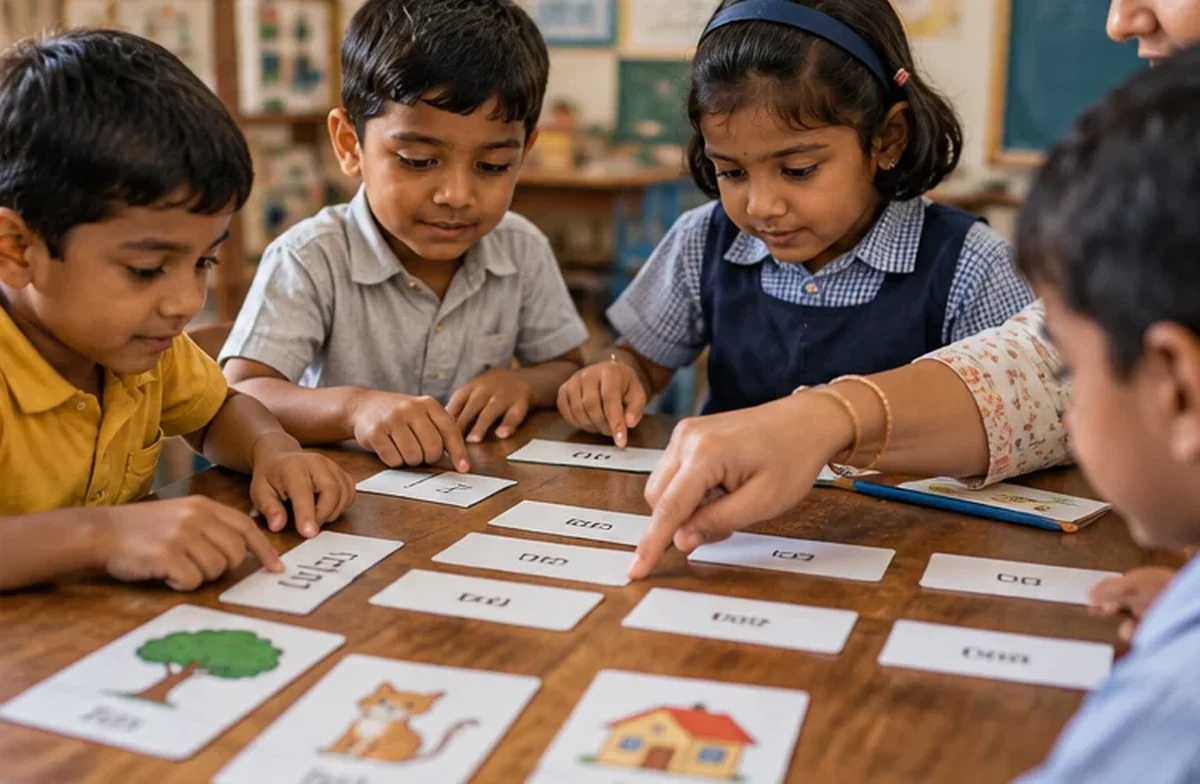
- Two-column sort: sort sentence cards into routines/facts and happening-now/temporary activities.
- Error repair: correct “She play every day” and “They is running” and explain why.
6. Contrast pairs reveal meaning
“I read before bed” describes a habit; “I am reading now” describes a current action. “He works in a shop” usually describes his job; “He is working late this week” describes a temporary situation. Ask students to point to clues, then gradually remove them in more difficult examples.
7. Short assessment
Complete: (1) My mother ___ tea every morning. (2) Look! The dog ___ across the road. (3) ___ your brother play football on Sundays? (4) We ___ a story right now. Possible answers: “makes” or “drinks” depending on the intended sentence, “is running,” “Does,” and “are reading.” Discuss the meaning behind each choice.
Frequently asked questions
Can present continuous describe the future?
Yes. It can describe arranged future activities, such as “We are visiting the museum tomorrow.” Teach this after pupils understand the core current-action meaning.
Why do we say “She plays” but “Does she play?”
The third-person -s appears in the present-simple positive form. With “does,” the auxiliary carries that marking and the main verb returns to its base form.
Are “always” and “now” absolute rules?
No. They are useful clues, but students should choose the tense that fits the intended meaning and context.