
Nouns, Pronouns and Verbs: A Simple Teaching Guide for Children
Clear explanations, examples, classroom games and a mini assessment to teach nouns, pronouns and verbs in the primary grades.
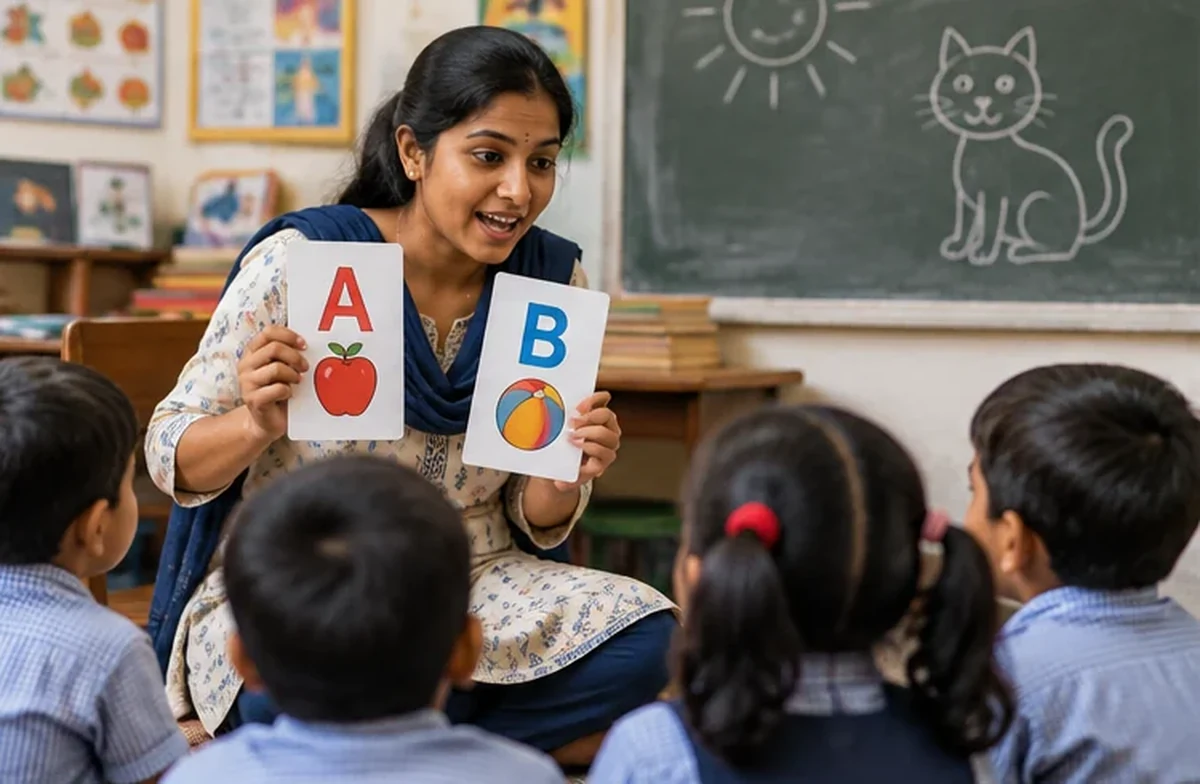
Nouns, pronouns and verbs are a useful starting point for primary grammar because children can connect them to people, objects and actions in their own classroom. Teach them as parts of meaningful sentences, with short explanations and spoken examples before longer written exercises.
1. Nouns name people, places, animals, things and ideas
Examples include “teacher,” “school,” “cat,” “pencil” and “friendship.” Begin with objects children see: book, desk, bag, window and chalk. Then move to less visible nouns such as joy, honesty or courage. A noun hunt asks pupils to name an object and use the noun in a complete sentence.
When learners are ready, introduce common and proper nouns. “River” is a common noun, while “Ganga” is a proper noun and takes a capital letter. Avoid a long list of noun subtypes before pupils can recognise nouns in sentences. Depth is more useful than labels copied without understanding.
2. Pronouns reduce unnecessary repetition
Compare “Mina has a book. Mina reads Mina's book” with “Mina has a book. She reads her book.” The second version is more natural, and pupils can hear the purpose of the change. Common personal pronouns include I, you, he, she, it, we and they; forms such as me, him, her, us and them appear in different sentence positions.
Teach reference carefully. If two girls are named in a story, “she” may be unclear. Ask pupils which person the pronoun refers to. This supports grammar and reading comprehension. Do not remove every repeated noun mechanically if doing so makes the meaning confusing.
3. Verbs express actions and states
Action verbs such as jump, draw, carry, read and swim can be acted out. Other verbs express a state: is, seem, know, belong and feel. Children who learn only “a verb is an action word” may miss “The room is quiet” or “I know the answer.” Introduce these through everyday sentences before the technical label.
4. A three-stage lesson for Classes 1–4
- Notice: show a picture of a child carrying a bag. Ask pupils to name the person, object and action.
- Build: write “Rina carries a bag.” Label Rina as the noun and carries as the verb, then replace Rina with “She.”
- Use: ask pairs to create three sentences about a picture and replace a repeated noun where the reference remains clear.
For younger pupils, use oral answers, pictures and word cards. Older pupils can analyse a short paragraph and improve repeated names. The grammar goal stays stable while the amount of text and independence increases.
5. Activities beyond copying lists
- Noun basket: place safe classroom objects in a basket; children name and sort them.
- Pronoun detective: improve a short paragraph with repeated names without making references unclear.
- Verb action circle: one pupil acts, another says the verb and a third uses it in a sentence.
- Sentence-builder cards: mix noun/pronoun cards with verb cards and form sensible sentences.
6. Common errors to look for
Children may confuse a noun with a describing word (“blue” is not the noun in “blue bag”), use “they” when the reference is unclear or omit the verb from a sentence. Ask the child to read the sentence aloud and explain who or what it is about and what is happening. Oral explanation can reveal a gap hidden by a multiple-choice answer.
7. Mini practice with answers
A. “The puppy sleeps.” Noun: puppy; verb: sleeps. B. “Maya and Rohan are friends. They play together.” Pronoun: they, referring to Maya and Rohan. C. “The soup is hot.” Soup is the noun, is expresses a state and hot describes the soup. Use one or two examples daily and revisit them in new contexts.
Frequently asked questions
Is “is” a verb even though it is not an action?
Yes. Verbs can express states as well as actions. “The room is quiet” uses “is” to link the subject with information about it.
When should a child use a pronoun?
Use a pronoun when the reader or listener can clearly identify the person or thing being referred to. Repeating a noun can be clearer than using an ambiguous pronoun.
What is the easiest way to teach nouns?
Start with real objects, people and places, then move to picture naming and sentence use. Introduce subcategories gradually.