
Build Vocabulary Fast: Synonyms, Antonyms, One-Word Substitution & Idioms
Vocabulary is easy to "study" passively — reading a word list — and much harder to actually retain without answering questions that force recall under pressure. The Vocabulary Series is built around exactly that: four focused practice categories instead of one long word list.
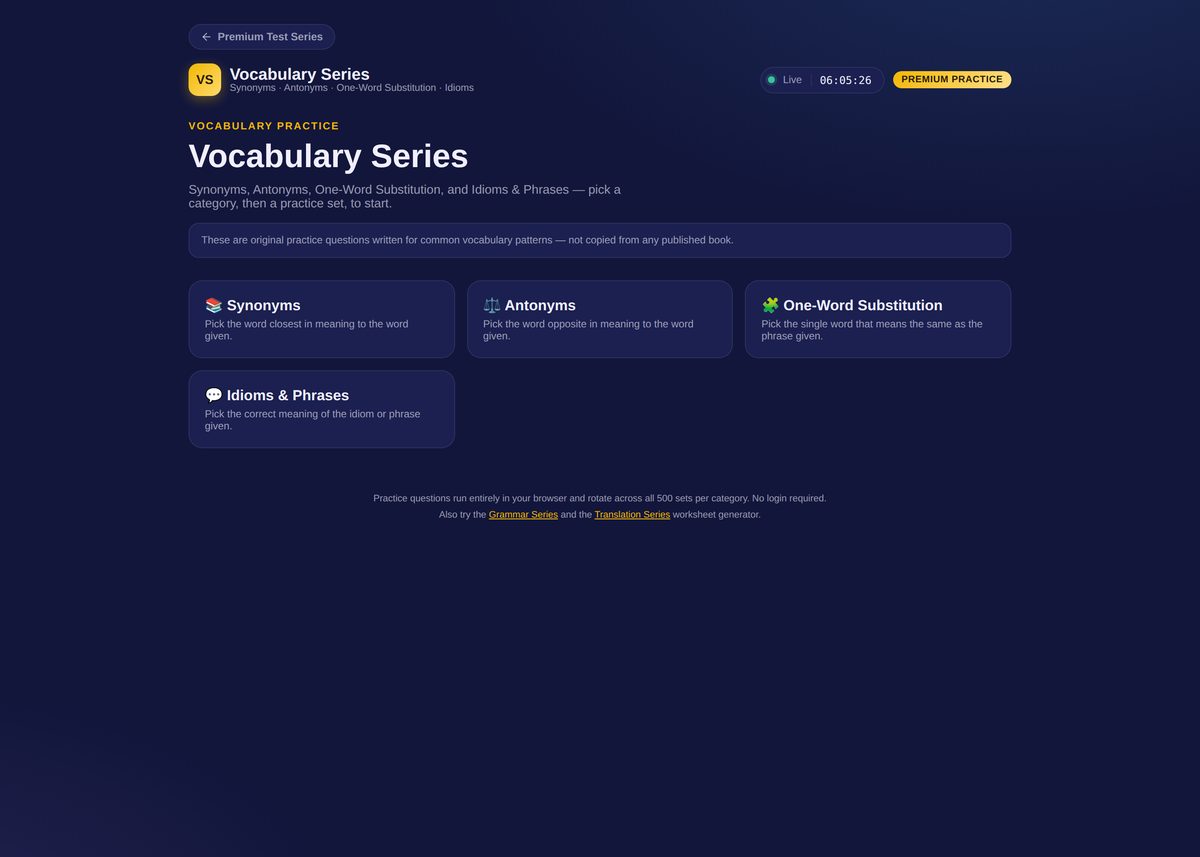
Step 1: Pick a category
- Synonyms — pick the word closest in meaning to the word given.
- Antonyms — pick the word opposite in meaning to the word given.
- One-Word Substitution — pick the single word that means the same as the phrase given.
- Idioms & Phrases — pick the correct meaning of the idiom or phrase given.
Step 2: Pick a practice set
Each category rotates across roughly 500 practice sets, so working through vocabulary practice regularly doesn't mean running out of fresh questions or seeing the same set twice in a row.
Step 3: Get scored instantly
Like the rest of MulVidya AI's practice series, questions are scored instantly — useful for quick five-minute drills between other work rather than a sit-down test session.
Common mistakes to avoid
- Only practicing Synonyms. It's the most familiar category, which makes it tempting to over-practice while Antonyms, One-Word Substitution, and Idioms lag behind — all four show up on real exams.
- Treating idioms literally. Idiom questions test the figurative meaning, not a literal reading of the words — if an answer feels too literal, it's usually the wrong one.
Related practice
Pair vocabulary practice with the Grammar Series, or see Free SSC, Railway, WBPSC & TET/CTET Practice Tests if you're prepping for a competitive exam where these question types appear directly.
Frequently Asked Questions
Do I need to log in to practice vocabulary sets?
No login is required — practice questions run entirely in your browser and rotate across all 500 sets per category.
Are these questions copied from a vocabulary book?
No — they're original practice questions written for common vocabulary patterns, not copied from any published book.
What's the difference between the four categories?
Synonyms asks you to pick the word closest in meaning to a given word; Antonyms asks for the opposite; One-Word Substitution asks for the single word that means the same as a given phrase; Idioms & Phrases asks for the correct meaning of a given idiom or phrase.
Is vocabulary practice useful for competitive exams too?
Yes — synonyms, antonyms, one-word substitution, and idioms are staple question types across SSC, Railway, WBPSC, and TET/CTET English sections.